- En
Choosing a transmission tower manufacturer should come down to six factors: engineering capability, manufacturing quality, material traceability, galvanizing control, production capacity, and project delivery performance.
For utilities and EPC contractors, the lowest price per ton is rarely the lowest project cost. A supplier that causes drawing revisions, dimensional problems, galvanizing defects, missing components, or shipment delays can affect foundation work, tower erection, conductor stringing, and ultimately the energization schedule.
The best transmission tower suppliers should therefore be evaluated as long-term engineering and supply-chain partners, not simply steel fabricators.
A qualified transmission tower manufacturer should be able to convert project specifications into repeatable, inspectable production.
During prequalification, evaluate the following areas:
Experience with the required voltage level and tower configuration
Engineering and shop-drawing capabilities
Steel procurement and material traceability
Cutting, drilling, welding, punching, and trial-assembly capability
Hot-dip galvanizing quality
Inspection and testing procedures
Monthly and annual production capacity
Packing, marking, container loading, and export experience
Ability to supply complete manufacturing and inspection records
The key question is not simply, Can this factory manufacture towers? It is, Can this factory manufacture our tower design repeatedly, document compliance, and deliver according to the EPC schedule?
There is no single international standard that covers every transmission tower project. The applicable requirements depend on the utility, country, voltage level, environment, structural design basis, and contract specification.
For example, IEC 60826 provides reliability-based loading and strength criteria for overhead transmission lines, while fabrication requirements may be governed by national standards or utility specifications.
Corrosion protection should also be clearly specified. ISO 1461:2022 defines general properties and test methods for hot-dip galvanized coatings on fabricated iron and steel articles, while ASTM A123/A123M covers hot-dip galvanized coatings on iron and steel products.
Before issuing a purchase order, the EPC contractor should establish a compliance matrix covering:
Design standard → steel grade → bolt specification → fabrication tolerance → welding requirements → galvanizing → inspection → tower testing → packing and marking.
A reliable manufacturer should review these requirements before production rather than resolving specification conflicts after fabrication has started.
Certificates alone are not enough.
A useful factory audit should follow the actual production route from raw steel to finished tower packages. Check whether steel plates and angles can be traced to mill certificates and production batches. Review cutting and hole-position tolerances, welding procedures, dimensional inspection records, galvanizing controls, and final packing.
For critical or customized tower designs, trial assembly is especially valuable. It helps identify mismatched holes, incorrect member orientation, connection problems, or drawing errors before hundreds of identical components reach the construction site.
Quality documentation may include:
Mill test certificates
Incoming material inspection records
Dimensional inspection reports
Welding inspection records where applicable
Galvanizing thickness records
Bolt and fastener certificates
Trial-assembly reports
Packing lists and bundle identification
Pre-shipment inspection records
This documentation is particularly important for EPC projects where several engineering, QA/QC, logistics, and site teams need to work from the same traceable information.
Very important, especially for towers installed in coastal, industrial, humid, or high-rainfall environments.
Galvanizing quality should not be judged only by appearance. Buyers should define the required coating standard, minimum coating thickness or mass where applicable, inspection method, repair procedure, and acceptance criteria in the project specification.
The manufacturer should also understand how component geometry affects galvanizing. Venting and drainage, surface preparation, member size, weld details, and handling after galvanizing can all influence the finished result.
Jintong, for example, supplies galvanized steel transmission towers and states that quality control is applied from raw-material procurement through fabrication and delivery.
Neither structure is universally better; the correct choice depends on route conditions and project priorities.
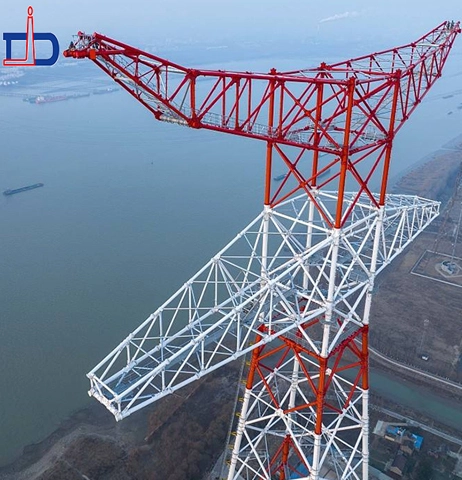
A conventional lattice tower is often preferred for long transmission corridors because it offers efficient structural performance, flexible tower configurations, and relatively convenient transportation in bundled members.
A tubular transmission tower, including steel pole-type structures, becomes attractive when the project has:
Limited right-of-way
Urban or suburban locations
Aesthetic requirements
Restricted foundation footprint
A need for faster or simplified field assembly
Specific utility requirements for compact structures
Tubular structures are made from hollow steel sections and can use flanged or other engineered connections depending on the design. Jintong manufactures electric steel tubular towers for transmission and distribution applications alongside conventional power line towers.
For EPC teams, tower selection should therefore be made at system level. Foundation cost, transport restrictions, crane requirements, erection time, right-of-way limitations, wind loading, corrosion protection, and lifecycle maintenance should all be considered—not just tower weight.
Tower manufacturing sits directly on the critical path of many overhead line projects.
The supplier must coordinate approved drawings, steel procurement, production, galvanizing, inspection, packing, and shipping with the required erection sequence.
This is why buyers should verify real production capacity, not only published annual capacity.
Ask the manufacturer:
What capacity is available during our production window?
Can production be divided according to erection lots?
How are tower members bundled and identified?
How quickly can missing or damaged members be reproduced?
How will design revisions be controlled after production begins?
A capable supplier should be able to build a manufacturing schedule around project priorities rather than simply offering a factory completion date.
Before final commercial evaluation, request enough evidence to compare suppliers on the same basis.
At minimum, the technical package should cover company qualifications, applicable certifications, manufacturing equipment, QA/QC procedures, relevant project references, production capacity, material specifications, galvanizing capability, inspection procedures, and proposed delivery schedule.
For major utility projects, it is also reasonable to request sample inspection records or conduct a factory audit before supplier approval.
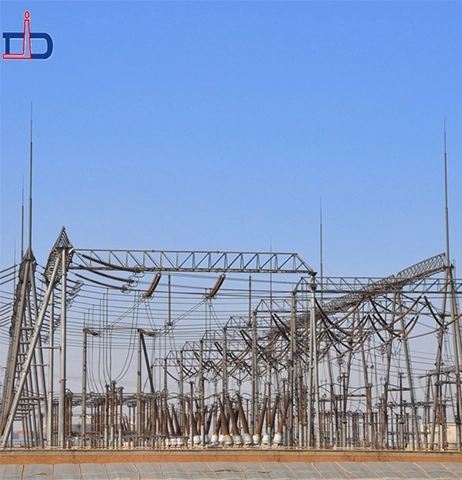
Established manufacturers should be comfortable with this level of technical evaluation. Tianjin Jintong Steel Tower, for example, has manufactured steel structures since 1990 and lists transmission line towers, substation structures, steel pipe poles, and other large steel structures among its core products.
When comparing transmission tower suppliers, avoid evaluating quotations only by price per metric ton.
A more useful commercial comparison includes:
Tower price + engineering support + inspection cost + packing + logistics + erection efficiency + potential rework + schedule risk.
A slightly lower fabrication price can quickly lose its advantage if tower members need site modification or if incomplete shipments stop an erection crew.
For utility and EPC procurement teams, predictable quality and delivery normally create more value than the lowest initial quotation.
Check engineering experience, manufacturing capability, quality systems, material traceability, galvanizing control, project references, documentation, and delivery capacity before comparing final prices.
Provide tower drawings or technical specifications, voltage level, tower types, quantities, steel requirements, design standards, galvanizing requirements, inspection requirements, delivery destination, and required schedule.
For large utility or EPC contracts, a factory audit is strongly recommended. It helps verify actual equipment, production capacity, QC procedures, galvanizing capability, traceability, and documentation systems.
Selecting a transmission tower manufacturer is ultimately a project-risk decision. The strongest supplier is not simply the company that can fabricate steel at the lowest cost. It is the manufacturer that can understand the engineering specification, maintain consistent production quality, prove compliance through documentation, protect the steel correctly, and deliver each tower package in the sequence required by the construction schedule.
Whether a project requires conventional lattice structures or a tubular transmission tower, utilities and EPC contractors should qualify suppliers on technical capability and execution reliability first, then optimize commercial terms.
For transmission line projects requiring customized tower configurations, galvanized steel structures, and coordinated production support, Tianjin Jintong Steel Tower provides power line towers and tubular steel tower solutions for different transmission and infrastructure requirements.