- En
Steel tube towers are increasingly used in high-voltage transmission projects where structural strength, limited right-of-way, installation efficiency, and long-term corrosion resistance are important. Compared with conventional lattice structures, a tubular steel tower offers a compact profile, fewer structural members, and efficient resistance to wind and torsional loads.
For utilities, EPC contractors, and transmission line developers, however, tower selection should never be based on appearance or voltage level alone. Conductor loads, span length, wind and ice conditions, terrain, corrosion exposure, foundation requirements, and line configuration must all be considered during engineering.
The closed tubular section provides high structural stiffness while maintaining a relatively compact footprint. This makes steel tube towers particularly useful for urban corridors, substation entrances, roadside routes, and other locations where available land is limited.
Their streamlined geometry can also reduce wind exposure compared with structures containing many individual angle-steel members. For high-voltage lines in demanding environments, the tower can be engineered around site-specific wind, ice, seismic, conductor, and longitudinal loads.
A properly designed power transmission steel tower must support much more than its own weight. Engineers need to evaluate:
Conductor and ground-wire loads
Wind pressure on the tower and conductors
Ice loading where applicable
Longitudinal loads caused by conductor tension
Line deviation and terminal loads
Seismic requirements
Electrical clearance requirements
Foundation and soil conditions
These factors ultimately determine the tower height, wall thickness, section dimensions, connection system, and foundation design.
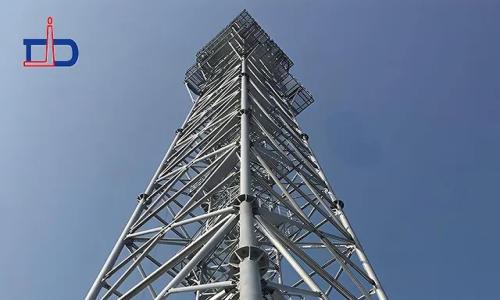
There is no universal answer because both structures have appropriate applications.
A tubular steel tower is often preferred where a smaller foundation footprint, cleaner appearance, fewer exposed connections, and faster field assembly are valuable. Factory-fabricated sections can be connected by slip joints or flanges, reducing the number of individual members that must be assembled on site.
Lattice towers, meanwhile, remain widely used for long-distance transmission routes, particularly where very large structures and economical transport of individual members are priorities.
The right choice should therefore be based on total project requirements rather than tower purchase price alone.
Corrosion protection is critical because transmission structures are expected to remain outdoors for decades.
Hot-dip galvanizing is commonly used to protect the steel surface against corrosion. In coastal, industrial, high-humidity, or chemically aggressive environments, engineers may need to specify additional corrosion requirements based on the actual exposure conditions. Jintong's power transmission structures can be supplied with hot-dip galvanized protection and coating systems selected according to project conditions.
For buyers, coating specifications should be confirmed before production rather than treated as a standard detail after fabrication.
Providing complete project information allows the manufacturer to develop a more accurate structural proposal.
Important data normally includes the required voltage level, tower function, circuit configuration, conductor specifications, tower height, span, line angle, wind speed, ice thickness, terrain conditions, corrosion environment, design standard, and foundation information.
For high-voltage projects, buyers should also review material certificates, welding procedures, dimensional inspection, trial assembly requirements, galvanizing quality, and documentation traceability.
Jintong manufactures steel tubular structures for power transmission and distribution applications, with product configurations covering different heights, materials, connection methods, and project-specific load requirements.
The voltage capability depends on tower geometry, insulation configuration, electrical clearances, and structural design. Jintong offers electric steel tubular tower configurations for transmission and distribution applications from 10 kV to 1000 kV.
Yes, when properly engineered. Their streamlined tubular sections provide favorable wind resistance, but actual wall thickness, diameter, height, foundation, and connection design must be calculated according to project wind loads.
Service life depends on steel quality, corrosion protection, installation environment, inspection, and maintenance. Good galvanizing and proper maintenance can significantly extend structural service life.
Yes. Height, section size, material grade, connection type, cross-arm arrangement, load capacity, and corrosion protection can all be adapted to specific transmission line conditions.
For a high-voltage transmission project, the manufacturer should be capable of supporting both fabrication and engineering requirements. Structural calculations, material control, welding quality, dimensional accuracy, galvanizing, trial assembly, documentation, and export packaging all influence final project reliability.
At Jintong Towers, steel tube towers can be customized according to voltage level, route conditions, wind and ice loads, terrain, and project standards. For a new transmission line or substation project, providing your technical specifications at the quotation stage helps our engineering team recommend a more suitable tower configuration and prepare an accurate proposal.