- En
A reliable high mast pole specification should define much more than the pole's nominal height. For lighting projects, the specification needs to establish the required high mast pole height, headframe configuration, luminaire capacity, raising and lowering system, structural design conditions, foundation interface, corrosion protection, electrical components, and supply scope.
For EPC contractors and project buyers, these details directly affect structural calculations, lighting coverage, installation requirements, maintenance access, and the final quotation. Two high mast poles with the same nominal height can have substantially different designs and prices if their headframes, lighting loads, wind conditions, or operating systems are different.
A useful procurement specification therefore needs to describe the complete pole assembly rather than treating the mast as a standalone steel column.
The core specifications normally cover pole height, shaft geometry, material grade, headframe arrangement, lighting equipment capacity, wind load, raising and lowering mechanism, foundation connection, surface treatment, and electrical configuration.
The high mast pole height is usually established from the required illumination area and photometric design. However, height should be determined together with the number, type, beam angle, mounting arrangement, and optical performance of the luminaires.
A typical technical specification should identify:
| Specification | Information to Define |
|---|---|
| Pole height | Overall height above foundation or finished ground level |
| Shaft | Polygonal/tapered configuration, section dimensions and wall thickness |
| Material | Structural steel grade and applicable standard |
| Headframe | Fixed or lowering type, size and luminaire capacity |
| Lighting load | Number, weight and projected area of luminaires |
| Wind design | Basic wind speed, exposure and applicable design standard |
| Raising/lowering system | Winch, cable, motor and control arrangement |
| Foundation interface | Base flange, anchor bolts and bolt-circle dimensions |
| Corrosion protection | Hot-dip galvanizing and specified coating requirements |
| Electrical system | Junction box, cables, control equipment and grounding |
| Accessories | Aviation obstruction devices, platforms, ladders or other project requirements |
The exact values should always be determined by the project's engineering requirements rather than by adopting a generic "standard" configuration.
High mast pole height is primarily determined by the required lighting coverage, target illuminance, luminaire photometry, mounting arrangement, site geometry, and structural design conditions.
A taller mast does not automatically produce better lighting. Increasing mounting height changes the illuminated area and light distribution, but the final arrangement must still satisfy the project's required average illuminance, uniformity, glare control, and other lighting criteria.
For this reason, buyers should provide the lighting designer's requirements when requesting a quotation. A manufacturer can then evaluate the appropriate mast height together with the headframe and luminaire arrangement.
Common project heights may vary considerably depending on the application. High mast systems used for highways, ports, container yards, airports, stadium surroundings, industrial facilities, and large parking areas may require different mounting heights and lighting configurations.
The important procurement point is to define exactly what the quoted height represents. It should be clear whether the stated dimension refers to the overall mast length, height above finished ground level, or another project-specific reference point.
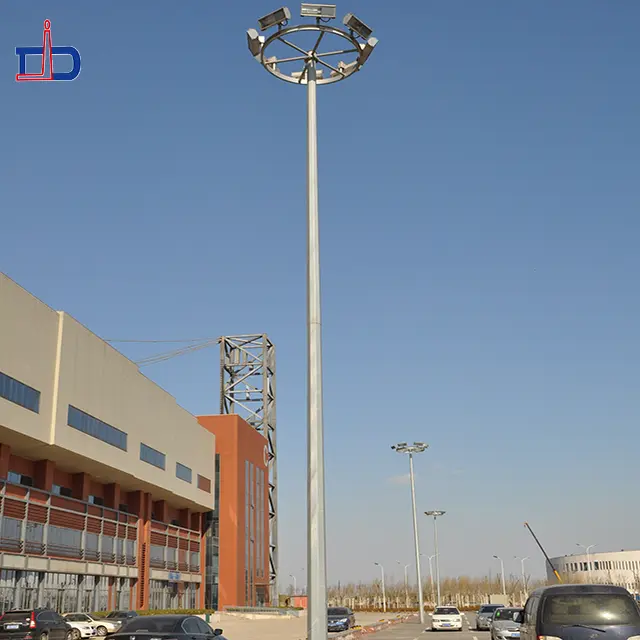
No. Lighting performance depends on the relationship between mast height, luminaire optics, mounting configuration, spacing, and the characteristics of the area being illuminated.
Increasing high mast pole height can allow a wider lighting distribution and potentially reduce the number of mast locations, but excessive mounting height can also influence illumination levels and installation economics.
A proper lighting layout should therefore establish the required mounting height before the structural pole is finalized.
For EPC procurement, it is useful to separate two decisions:
Lighting design: determines where and how much light is required.
Structural design: determines whether the selected mast can safely support the required luminaires and withstand the site's environmental loads.
The pole manufacturer should receive both sets of requirements before final production drawings are approved.
The headframe is the assembly installed at the top of the mast to support the luminaires. Its configuration has a direct effect on the number and positioning of lighting fixtures.
Depending on the project, a headframe may accommodate several luminaires arranged around the mast or in a specified directional pattern. For large-area lighting, the headframe can be designed to distribute luminaires toward different zones of the site.
The headframe must be compatible with the luminaire dimensions, mounting brackets, cable routing, maintenance mechanism, and structural loading.
For a lowering-type high mast, the headframe is also part of the movable assembly. Its weight and geometry therefore become important inputs for the winch, lifting cable, motor, and braking system.
This is why a quotation that states only "high mast pole, 30 m" leaves too much technical information undefined.
A fixed headframe remains at the top of the mast, while a lowering headframe can be brought down to ground level or another accessible position for maintenance, depending on the system design.
For high mast installations with numerous luminaires, a lowering system can reduce the need for specialized elevated maintenance equipment. The operator can lower the lighting assembly for inspection, lamp replacement, cleaning, and other maintenance work.
However, a lowering system introduces additional mechanical components. The specification may therefore need to cover the winch, lifting cable, motor, gearbox, electrical controls, locking arrangement, and other safety-related components.
The decision should be based on the project's maintenance strategy rather than simply selecting the mechanically more complex option.
There is no universal number because luminaire capacity depends on the headframe design, luminaire weight, projected area, mounting arrangement, and structural loading conditions.
The number of luminaires should be specified together with their individual weight and dimensions. A high mast supporting six compact LED luminaires may have a very different structural requirement from one supporting six larger floodlights with greater wind-exposed surface area.
For this reason, EPC buyers should avoid specifying only "number of lights." The RFQ should provide the quantity, unit weight, dimensions, mounting orientation, and projected area of the proposed luminaires whenever available.
These parameters allow the manufacturer to incorporate the actual lighting load into structural calculations.
Wind loading is one of the most important structural inputs for high mast design because the mast and elevated luminaires are exposed to significant wind forces.
The design calculation needs to consider the project's specified basic wind speed and applicable structural standard, as well as the pole geometry, luminaire projected area, headframe configuration, terrain or exposure conditions, and other relevant parameters.
The wind load on the lighting equipment should not be overlooked. A large luminaire or headframe can contribute significant projected area at the top of a tall mast.
Consequently, changing the headframe or replacing the specified luminaires after structural design approval can affect the original calculation. Any major change in lighting equipment should be reviewed against the approved structural design.
High mast shafts are commonly manufactured from structural steel formed into tapered polygonal sections and connected by suitable joints or fabrication methods.
The high mast pole specification should identify the required steel grade and applicable material standard, together with minimum thickness and fabrication requirements where relevant.
For outdoor applications, hot-dip galvanizing is commonly used to provide corrosion protection. The procurement specification should state the applicable galvanizing standard and coating requirements rather than simply describing the pole as "galvanized."
Project conditions should also be considered. Coastal locations, industrial environments, high-humidity regions, and areas exposed to de-icing chemicals may require particular corrosion-protection considerations.
Supply scope should be clearly defined because the term "high mast pole" can refer to either the steel mast alone or a complete lighting support system.
Depending on the project, the supply package may include the tapered mast shaft, base flange, anchor bolts, headframe, raising and lowering mechanism, winch, motor, cable, electrical control box, luminaire mounting brackets, junction box, grounding components, and other accessories.
Some projects may also require aviation obstruction lights, maintenance equipment, special identification plates, or other site-specific components.
The RFQ should clearly distinguish between:
Included: components supplied and tested by the manufacturer.
Excluded: items provided by the EPC contractor or another supplier.
Optional: components that can be quoted separately.
This prevents a common procurement problem in which two suppliers appear to offer similar prices but are actually quoting different levels of completeness.
A professional quotation should be supported by sufficient technical documentation to allow engineering and procurement teams to verify the proposed configuration.
The package may include general arrangement drawings, foundation interface details, material specifications, structural calculation information where required, galvanizing specifications, headframe drawings, raising/lowering system details, electrical diagrams, inspection documentation, and packing information.
The supplier should also identify the applicable standards and clearly state the design assumptions used for the quotation.
For projects involving multiple mast heights, it is particularly useful to request separate technical and commercial data for each height and configuration. This allows the EPC team to compare the effect of height, lighting load, and headframe design without mixing different technical assumptions.
The relationship is not simply linear.
Increasing high mast pole height generally affects steel consumption, shaft dimensions, structural design requirements, foundation loads, transportation, erection methods, and the capacity of the raising and lowering system.
A taller mast may also require different lifting equipment or installation procedures. The additional cost therefore extends beyond the extra length of steel.
At the same time, a taller mast can potentially cover a larger area, which may reduce the number of pole locations required by the lighting layout. The project-level economic effect should consequently be evaluated using the complete lighting design rather than comparing pole prices alone.
The most effective approach is to create a standardized technical schedule before requesting quotations.
The schedule should establish the mast height, tower type, headframe arrangement, luminaire quantity and weight, wind design parameters, material requirements, galvanizing, mechanical lifting system, electrical equipment, foundation interface, inspection, documentation, packaging, and delivery terms.
Where the final luminaire model has not yet been selected, the RFQ should provide a maximum allowable weight and projected area rather than leaving the load undefined.
This gives manufacturers a consistent engineering basis and makes supplier quotations genuinely comparable.
A complete high mast pole specification should define the mast as an integrated structural and lighting-support system. Height is an important starting point, but headframe configuration, luminaire loading, wind conditions, lifting mechanism, steel specifications, corrosion protection, and supply scope can have an equally significant effect on the final design.
For EPC contractors and project buyers, the most important step is to establish these parameters before comparing quotations. Defining the high mast pole height together with the actual lighting load and maintenance requirements allows manufacturers to develop an appropriate structural configuration and provide a more accurate commercial offer.
When the RFQ clearly defines both technical requirements and supply boundaries, procurement teams can compare suppliers on a genuinely like-for-like basis while reducing specification changes, commercial disputes, and installation issues later in the project.
It varies by application and lighting design. Highway, port, airport, industrial, and large-area lighting projects can require different mast heights.
It supports and positions the luminaires at the top of the mast and, in lowering systems, forms part of the movable lighting assembly.
The number depends on the headframe design, luminaire weight, dimensions, wind load, and structural capacity.
No. It depends on the maintenance strategy, site conditions, mast configuration, and project requirements.
At minimum, provide mast height, luminaire quantity and weight, wind conditions, headframe arrangement, material requirements, galvanizing, lifting system, accessories, quantities, and delivery requirements.
It can. Greater height may increase structural loads and overturning effects, but the final foundation requirements depend on the complete structural design and site conditions.