- En
Traffic sign pole specifications should be determined from the sign dimensions, mounting arrangement, required outreach, wind loading, road geometry, clearance requirements, and site conditions. The sign itself is not an isolated load: its projected area and position create forces that must be transferred through the support structure into the foundation.
For highway and major-road projects, a properly specified highway sign support therefore needs to be engineered around the complete sign assembly rather than selected from a standard pole height or pipe diameter.
For EPC contractors and road infrastructure buyers, the most important information to establish before requesting quotations includes sign size and weight, mounting height, horizontal span or outreach, number of supports, design wind speed, road clearance, foundation conditions, material requirements, corrosion protection, and installation constraints.
The most important inputs are the sign area, sign elevation, mounting arrangement, outreach, wind conditions, road geometry, and foundation requirements.
A typical specification schedule should cover:
| Parameter | Information to Define |
|---|---|
| Sign area | Width, height, total projected area |
| Sign weight | Sign panel, frame and attached components |
| Mounting height | Clearance from roadway or ground to sign |
| Outreach | Horizontal distance from support to sign position |
| Support arrangement | Single post, twin post, cantilever or overhead structure |
| Wind load | Basic wind speed and applicable design standard |
| Road geometry | Lane configuration, shoulder width and alignment |
| Clearance | Vertical and horizontal clearances |
| Material | Steel grade and applicable standard |
| Corrosion protection | Galvanizing/coating requirements |
| Foundation | Base plate, anchor bolts and foundation design parameters |
| Accessories | Brackets, clamps, ladders, maintenance platforms or other items |
The exact values should be established from the road authority's design criteria and project drawings.
Sign area is one of the most important structural inputs because a larger sign presents a greater surface to wind.
The wind force acting on the sign assembly is influenced by the exposed area, wind pressure, aerodynamic characteristics, and mounting configuration. As the sign becomes larger, the resulting force and overturning moment at the support can increase.
The location of the sign relative to the pole also matters. A large sign mounted farther from the vertical support creates a greater lever arm, increasing the bending moment that the support structure must resist.
This means that two traffic sign poles with the same overall height can require substantially different structural sections if one supports a much larger sign or has a longer outreach.
For procurement, the RFQ should therefore state the actual sign dimensions and mounting position, rather than simply specifying the required pole height.
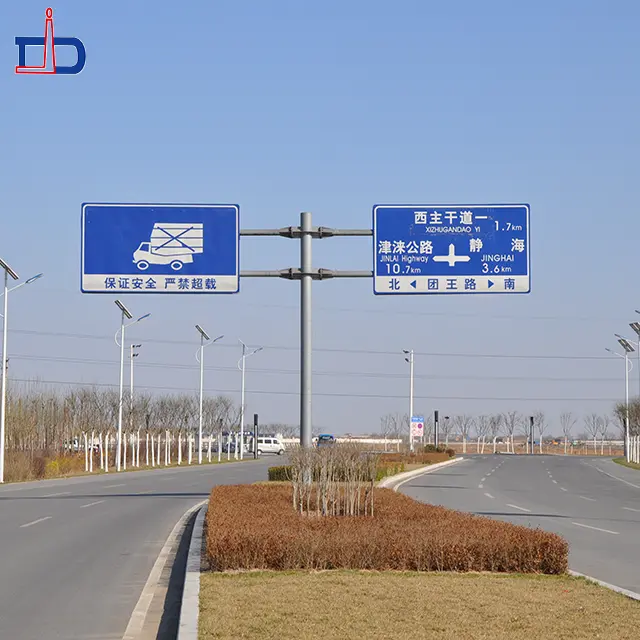
Outreach is determined primarily by the road layout and the required sign position.
For a cantilever or overhead sign structure, the support must place the sign over the required lane or road area while maintaining the necessary clearance from traffic and roadside obstacles.
A longer outreach increases the structural moment at the support and can influence the required shaft diameter, wall thickness, cross-section, foundation loading, and connection design.
The relationship is particularly important for large highway signs. A relatively modest increase in outreach can have a noticeable effect on structural requirements because the wind force acting on the sign is transferred through a longer lever arm.
A traffic sign pole manufacturer should therefore receive both the sign dimensions and the required sign position when preparing the structural design and quotation.
A highway sign support is the structural system used to hold traffic signs at the required position and elevation along a road or highway.
Depending on the road layout and sign size, the support may take the form of a roadside post, twin-post structure, cantilever support, or overhead sign structure.
The selection depends on several factors, including the number of lanes, sign dimensions, required lateral position, roadway clearance, available roadside space, and maintenance requirements.
For larger signs requiring coverage across one or more lanes, cantilever or overhead arrangements may provide the necessary sign position without placing conventional roadside posts directly in the traffic area.
The support should always be designed as part of the complete road-sign system rather than treated as a generic steel pole.
Yes, but sign size is only one of several factors that determine the structural section.
A larger sign generally increases wind load, while greater mounting height or outreach can increase the bending moment applied to the support. Wind speed, terrain exposure, material grade, pole geometry, connection configuration, and foundation conditions also affect the required section.
For this reason, there is no reliable rule that a particular sign size always requires a particular pole diameter.
A professional traffic sign pole manufacturer should perform the structural calculation based on the project's actual design parameters instead of selecting the pole section solely from the sign dimensions.
Traffic sign structures must provide sufficient clearance for vehicles and road users while positioning the sign where it can be seen effectively.
Vertical clearance is particularly important for overhead signs. The required clearance depends on the road classification, authority requirements, roadway configuration, and applicable design standard.
Horizontal clearance also needs to be considered. The support should not create an unacceptable roadside hazard or interfere with shoulders, barriers, drainage systems, pedestrian facilities, utilities, or other roadside infrastructure.
For EPC projects, clearance requirements should be established from the road authority's drawings and standards before finalizing the pole geometry.
A structural design that satisfies the sign load but fails to accommodate the site's clearance requirements is not a complete solution.
Wind loading is often the controlling structural consideration for large traffic signs.
The support structure needs to resist the wind acting on both the sign panel and the pole itself. The sign's projected area, mounting height, shape, position, and exposure all influence the resulting load.
For cantilever structures, the combination of sign wind force and outreach can create significant bending at the vertical support. For overhead structures, the load distribution between multiple supports and the horizontal member must also be considered.
The applicable design wind speed should come from the project's location and governing road or structural standard. A supplier should not assume a generic wind speed when preparing the final engineering design.
Site conditions can significantly affect both the pole design and foundation.
Before installation, the project team should verify the available roadside space, existing utilities, drainage, pavement structure, soil conditions, underground services, barrier locations, and construction access.
Foundation design is particularly site-dependent. The support must transfer vertical, lateral, and overturning loads into the ground through an appropriately designed foundation. Soil bearing capacity and other geotechnical conditions can therefore influence foundation dimensions and reinforcement.
For replacement projects, existing foundations should not automatically be reused simply because the new pole appears similar. A new sign may have a different area, weight, or outreach, changing the structural load transmitted to the foundation.
Steel is widely used for traffic sign supports because it provides the required combination of structural strength, manufacturability, and durability.
The traffic sign pole specifications should identify the steel grade, applicable material standard, shaft geometry, plate or section thickness, welding requirements, and connection details where relevant.
For outdoor road infrastructure, hot-dip galvanizing is commonly specified as corrosion protection. The RFQ should identify the applicable galvanizing standard and coating requirements instead of using only a general description such as "galvanized steel."
Projects in coastal or highly corrosive environments may require additional consideration of the exposure conditions and the long-term corrosion-protection strategy.
A complete quotation should clearly identify which components are included in the manufacturer's scope.
Depending on the project, the supply package may include the pole or structural support, base plate, anchor bolts, sign mounting brackets, clamps, horizontal members, access components, and corrosion-protection treatment.
For a cantilever or overhead highway sign support, the supply scope may also include the horizontal arm or overhead beam and its connection system.
Foundation construction, traffic management during installation, sign panels, electrical equipment, or civil works may remain outside the manufacturer's scope unless specifically requested.
This distinction is important when comparing quotations. A lower price may simply represent a narrower supply package.
A like-for-like comparison should combine technical and commercial information.
The procurement team should first confirm that every supplier is quoting for the same sign area, sign weight, mounting height, outreach, wind design, material specification, corrosion protection, and support configuration.
The commercial comparison can then be organized around:
Structural supply: pole, arms, plates, brackets and connection components.
Corrosion protection: galvanizing or other specified treatment.
Accessories: clamps, sign mounting hardware and maintenance-related components.
Engineering: structural calculations, drawings and technical documentation.
Inspection: material certificates, dimensional inspection, coating inspection and any required third-party testing.
Logistics: packing, loading, inland transportation, export handling and agreed delivery terms.
This approach allows EPC buyers to distinguish a genuine difference in manufacturing efficiency from a difference in technical assumptions or supply scope.
For customized highway projects, the manufacturer should be involved before production rather than only after the final dimensions have been fixed.
A qualified traffic sign pole manufacturer can use the project's sign dimensions, outreach, wind conditions, material requirements, and foundation interface to develop the structural configuration and production drawings.
The manufacturer should also be able to clarify how changes in sign size, mounting position, or support arrangement affect the structural design.
This is particularly valuable for projects with multiple sign types. Standardizing support configurations where engineering conditions permit can simplify procurement, fabrication, spare parts, transportation, and installation.
A well-prepared RFQ should provide enough information for every supplier to work from the same engineering basis.
The documentation should ideally include the sign layout, sign dimensions and weight, required mounting elevation, outreach, road cross-section, design wind conditions, applicable standards, material requirements, galvanizing specification, foundation interface, quantities, inspection requirements, packaging, and delivery location.
If the final sign panel has not been selected, the EPC contractor should provide a maximum design area, weight, and projected surface area so that the manufacturer can design the support for a defined load.
This avoids one of the most common procurement problems: suppliers submitting technically different designs under the same product description.
Effective traffic sign pole specifications begin with the sign and the site, not with a standard pole diameter. Sign area determines a major portion of the wind exposure, while outreach influences the structural moment. Mounting height, roadway clearance, wind conditions, support configuration, and foundation conditions then determine how those loads must be carried safely.
For highway projects, the highway sign support should be specified as a complete structural system, including its horizontal members, connections, corrosion protection, and installation interface.
EPC buyers can achieve more accurate quotations by giving the traffic sign pole manufacturer a consistent engineering basis and requiring suppliers to clearly state their inclusions and assumptions. This creates a genuine like-for-like comparison and reduces the risk of design changes, cost additions, and installation problems after procurement.
Sign area, sign weight, outreach, mounting height, wind load, material grade, and structural design requirements all affect the required pole size.
Generally, yes. A larger exposed sign can generate greater wind force and bending moment, but the final pole section depends on the complete structural design.
It positions and supports highway signs at the required elevation and lateral location while transferring environmental and structural loads safely to the foundation.
Greater outreach increases the lever arm between the sign load and the vertical support, which can increase bending and foundation loads.
Sign dimensions, weight, mounting height, outreach, wind conditions, support arrangement, material requirements, quantities, corrosion protection, and delivery requirements should be provided.
Hot-dip galvanizing is commonly used for outdoor steel sign supports, but the required coating specification should follow the project's applicable standard and environmental conditions.