- En
In modern power transmission, telecommunications, wind energy, and infrastructure construction, choosing the right tower structure is critical for project safety, performance, maintenance costs, and long-term reliability. Among the most widely used tower structures are the tubular tower and the lattice tower.
Although both serve similar purposes—supporting electrical lines, antennas, lighting systems, or communication equipment—they differ significantly in structure, appearance, installation methods, durability, and overall project suitability.
A tubular tower is a tower structure manufactured primarily from hollow steel tubes or cylindrical steel poles. These towers are usually monopole or multi-pole structures with smooth surfaces and modern appearances.
Tubular towers are commonly used in:
Power transmission lines
Telecommunication networks
Street lighting systems
Wind monitoring stations
Urban infrastructure projects
Because of their streamlined design, tubular towers require less ground space and are often preferred in cities or environmentally sensitive areas.
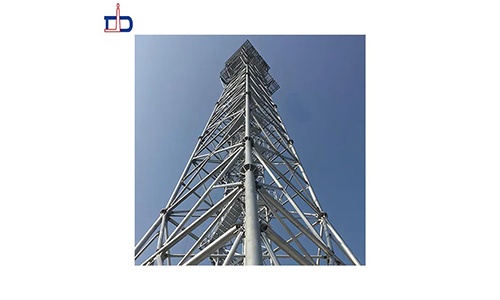
A lattice tower is a framework structure built from multiple steel angle sections connected together in a crisscross pattern. These towers are widely recognized in high-voltage transmission networks around the world.
Lattice towers are especially common in:
Long-distance transmission lines
Ultra-high-voltage power systems
Rural power infrastructure
Heavy-load telecom systems
Industrial utility networks
Their open-frame structure distributes loads efficiently and provides excellent stability for carrying heavy conductors and equipment.
Although tubular towers and lattice towers may serve similar functions, their structural designs and project advantages are very different.
The most obvious difference lies in the structural configuration.
Uses hollow steel tubes
Typically monopole or polygonal structures
Smooth external surface
Minimal number of visible components
Uses interconnected steel angle members
Open truss-style framework
Multiple bolted connections
Complex geometric structure
Tubular towers generally provide a cleaner and more modern appearance, while lattice towers focus more on structural efficiency.
Visual aesthetics are increasingly important in modern infrastructure development.
Sleek and modern appearance
Lower visual pollution
Better suited for urban environments
Easier integration into city landscapes
Functional industrial appearance
Widely accepted in rural and industrial areas
Easier inspection due to open structure
In cities, governments and communities often prefer tubular towers because they occupy less visual space.
Tubular towers require significantly less ground area.
Small foundation footprint
Ideal for congested urban locations
Easier right-of-way management
Larger base dimensions
Requires more installation space
Better suited for open rural areas
When land availability is limited, tubular towers often become the preferred option.
Lattice towers typically offer higher load-bearing capability.
Excellent for ultra-high-voltage transmission
Supports heavy conductors
Performs well over long spans
Better for extremely heavy loads
Strong wind resistance
Suitable for medium and high-voltage systems
Effective for telecom equipment support
For extremely demanding transmission applications, lattice towers are often more economical.
Choosing the right tower depends on project requirements, environmental conditions, budget, and infrastructure goals.
The project is located in an urban area
Aesthetic appearance is important
Land availability is limited
Faster installation is required
Lower maintenance is preferred
The project involves telecom or medium-voltage transmission
Tubular towers are increasingly used in smart city infrastructure and modern telecom expansion projects.
The project involves ultra-high-voltage transmission
Heavy conductor loads are required
Long-distance transmission is necessary
The installation site is remote
Cost efficiency is critical for large-scale deployment
Lattice towers remain the preferred choice for many national power grid projects.
A tubular tower is commonly used for power transmission, telecommunications, street lighting, surveillance systems, and urban infrastructure projects. Its compact footprint and modern appearance make it especially suitable for cities and residential areas.
A lattice tower is primarily used for high-voltage and ultra-high-voltage transmission lines, long-distance power networks, industrial infrastructure, and heavy-load telecom systems. Its truss structure provides excellent strength and stability.
Tubular towers are typically manufactured from galvanized steel, high-strength structural steel, or weather-resistant steel materials. Hot-dip galvanization is commonly applied to improve corrosion resistance and extend service life.
Both tubular towers and lattice towers play essential roles in modern infrastructure systems. The best choice depends on your project’s technical requirements, environmental conditions, budget, and aesthetic expectations.
Tubular towers offer modern design, compact installation, lower maintenance, and excellent urban compatibility.
Lattice towers provide superior heavy-load performance, cost efficiency for large-scale transmission, and proven reliability in demanding environments.
As infrastructure demands continue to evolve, selecting the right tower solution becomes increasingly important for operational efficiency and long-term project success.
Manufacturers such as JUDING continue to develop advanced tower technologies that improve structural performance, corrosion resistance, installation efficiency, and overall lifecycle value for global energy and telecom projects.