- En
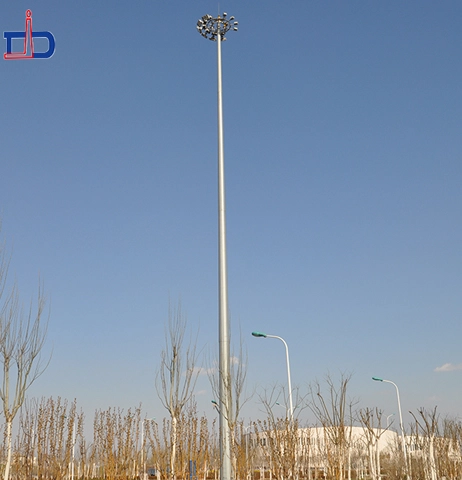
A high mast light pole is a tall, high-strength steel structure designed to support multiple lighting fixtures at a considerable height — typically ranging from 20 to 50 meters — to illuminate large outdoor areas such as highways, airports, stadiums, ports, and industrial zones.
Unlike conventional street light poles, high mast light poles are engineered for wide-area, uniform illumination, superior wind resistance, and ease of maintenance through specialized raising and lowering systems.
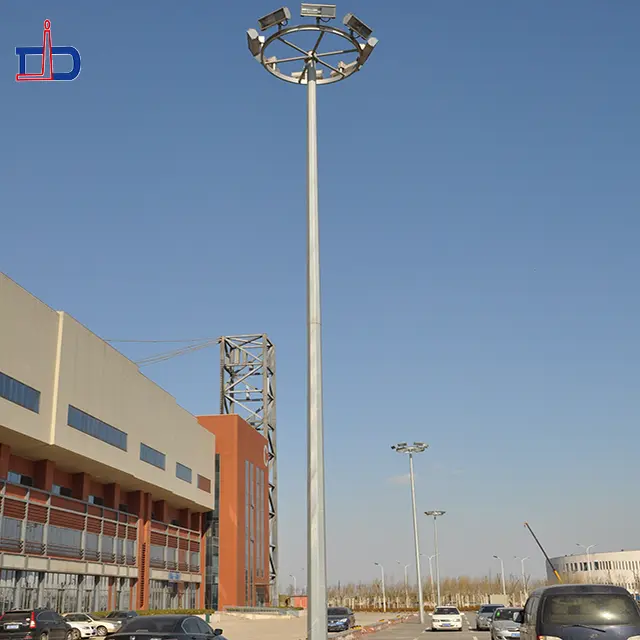
In large-scale outdoor environments, uniform lighting is crucial for safety, visibility, and operational efficiency. A high mast light pole achieves this by elevating powerful luminaires high above ground level, allowing light to disperse evenly over a wide area.
These poles are not merely tall street lamps — they are engineered steel structures designed to handle heavy dynamic loads, withstand harsh environmental conditions, and ensure decades of reliable service.
Typically, a high mast system includes:
Steel pole structure
Lighting fixtures (LED or HID types)
Lifting mechanism (manual or motorized)
Foundation and anchor bolts
Electrical and control system
Depending on their application and design specifications, high mast light poles can be categorized into several types:
A fixed high mast pole has a permanent head frame where luminaires are mounted. Maintenance requires lifting equipment such as a crane or bucket truck.
Advantages: Simple, economical design
Applications: Highway junctions, open parking areas
This design includes a motorized or manual winch system that allows the luminaire ring to be lowered to ground level for easy maintenance.
Advantages: Safe and convenient maintenance without climbing
Applications: Airports, ports, sports complexes, refineries
These poles can be tilted from the base for servicing.
Advantages: Ideal for areas where climbing or winching is impractical
Applications: Smaller industrial zones or restricted-access sites
The design of a high mast light pole is a complex engineering process governed by national and international standards such as GB/T 1499, EN 40, and ASTM A123. Engineers evaluate multiple parameters to ensure safety, longevity, and performance.
The pole height is selected based on the required lighting area and lux level. A typical 30–40 m pole can illuminate an area of up to 10,000–15,000 m².
Wind pressure increases exponentially with height. The pole's tapered octagonal or polygonal cross-section is designed to minimize wind resistance while maintaining high rigidity.
Common materials: Q345B, Q420, or S355 steel
Surface treatment: Hot-dip galvanizing (minimum 85μm coating) for anti-corrosion performance
Optional powder coating or epoxy painting for coastal or desert environments
Foundation design depends on soil bearing capacity, pole height, and wind load.
Anchor bolts are typically made of high-tensile steel (Grade 8.8 or above) to ensure secure fixation.
Each high mast includes lightning protection, earthing systems, and overvoltage safeguards to prevent damage to electrical components.
At Jintong Towers, each high mast light pole is produced using precision-controlled processes to meet stringent quality standards:
Design & Structural Analysis — Customized per project requirements
Raw Material Preparation — Certified steel with mill test reports
CNC Cutting & Rolling — Formed into tapered or polygonal segments
Automatic Submerged Arc Welding — Ensures consistent strength
Hot-Dip Galvanizing — Full immersion for 100% corrosion protection
Trial Assembly & Quality Check — Ensures proper fit and alignment
Packaging & Shipment — Marked components for quick on-site erection
All poles conform to ISO 9001:2015 and relevant IEC and GB/T standards.
High mast lighting is used wherever wide and uniform illumination is essential:
Highways and Interchanges – Improves traffic visibility and safety
Airports and Seaports – Supports round-the-clock logistics operations
Sports Stadiums – Ensures broadcast-quality illumination
Industrial Yards and Warehouses – Enhances security and productivity
Public Squares and Terminals – Provides aesthetic and functional lighting
One high mast can replace multiple conventional light poles, reducing clutter and maintenance costs.
Designed to withstand extreme wind speeds, storms, and seismic activity.
Lowering systems allow safe maintenance at ground level — no need for cranes.
With hot-dip galvanizing and precision welding, service life can exceed 25–30 years.
Modern poles are designed with sleek finishes and minimal visual obstruction, blending seamlessly with urban infrastructure.
The performance of a high mast light pole heavily depends on the quality and configuration of its lighting system.
Typical arrangements include 6, 8, 12, 16, or 24 floodlights mounted in a circular or semi-circular ring.
LED technology has largely replaced HID lamps due to energy efficiency and longevity.
Modern high mast systems integrate:
Photocell or timer controls
Remote monitoring via GSM or IoT systems
Dimming control for energy saving
Each luminaire is positioned with precise tilt and rotation angles to achieve uniform illumination with minimal glare.
To ensure reliability and safety:
Inspect anchor bolts annually for corrosion or fatigue
Check winch cables for wear and lubrication every 6–12 months
Verify galvanizing layer thickness every few years
Clean and realign luminaires periodically for optimal performance
Routine inspection minimizes downtime and extends operational lifespan.
| Feature | High Mast Light Pole | Street Light Pole |
|---|---|---|
| Height | 20–50 meters | 6–12 meters |
| Lighting Area | 5,000–15,000 m² | 50–200 m² |
| Number of Fixtures | 6–24 | 1–2 |
| Maintenance | Ground-level winch | Manual climbing |
| Applications | Highways, ports, airports | Streets, pathways |
The key difference lies in illumination range and structural complexity — high masts are designed for industrial-scale coverage.
As a leading high mast light pole manufacturer, Jintong Towers provides end-to-end lighting structure solutions — from engineering design to fabrication and installation.
Decades of manufacturing experience in steel poles and towers
Advanced CNC and galvanizing facilities
Custom designs for extreme wind, coastal, or desert environments
Compliance with ISO, GB/T, and IEC standards
Global export capability with modular packaging
We combine engineering precision, superior material quality, and responsive technical support to deliver lighting structures that stand tall — both in performance and reliability.
A high mast light pole is far more than a lighting column — it's a precision-engineered steel structure that ensures visibility, safety, and operational continuity across vast areas.
From highways to industrial facilities, these poles offer a durable and efficient lighting solution with minimal maintenance and long-term value.
With advanced manufacturing technology and strict quality control, Jintong Towers is your trusted partner for high mast light pole solutions — providing superior engineering, global reliability, and professional service for every project.
Most high mast poles range from 20 to 50 meters, depending on lighting requirements and site conditions.
Typically between 6 and 24 LED floodlights, arranged in circular or symmetrical configurations.
Poles are hot-dip galvanized with optional powder coating for long-term corrosion resistance.
With proper design, material selection, and maintenance, service life can exceed 30 years.
Yes. Jintong Towers designs and manufactures poles according to GB/T, ASTM, and IEC standards, tailored to each project's environmental and regulatory requirements.