- En
In power transmission and telecom infrastructure, the choice between a transmission tower and a monopole is a high-impact decision—technically, financially, and operationally. Both serve the essential purpose of supporting overhead lines or communication equipment, yet they differ significantly in structural design, load capacity, deployment logistics, and cost-performance efficiency.
As a leading manufacturer and exporter of both tower types, Jintong Towers frequently helps global clients evaluate these options for projects ranging from rural EHV transmission to urban telecom deployments. This article will clarify the technical and commercial differences between these two steel structure types to assist your procurement and engineering teams in making optimal decisions.

A monopole tower is a self-supporting structure built around a single vertical steel shaft rather than the multi-leg framework used in a lattice tower. For power transmission applications, the shaft is typically tubular, tapered, and circular or polygonal, with crossarms and insulators configured to support overhead conductors.
Because a monopole uses a single structural footprint, it is particularly useful for transmission routes where available land or right-of-way is limited. The final tower height, conductor arrangement, foundation, and structural capacity must be engineered according to the electrical configuration, span, line angle, environmental loads, soil conditions, and applicable project standards.
A monopole transmission line is an overhead power transmission system in which conductors are supported by single-shaft tubular steel structures instead of conventional multi-leg lattice towers. Depending on the route and structural requirements, monopoles can be engineered for straight-line suspension positions, line angles, terminal locations, and other project-specific configurations.
Their compact footprint makes monopole transmission structures especially attractive for urban and suburban corridors, road-side routes, substation approaches, and other locations where conventional lattice tower foundations would require more space.
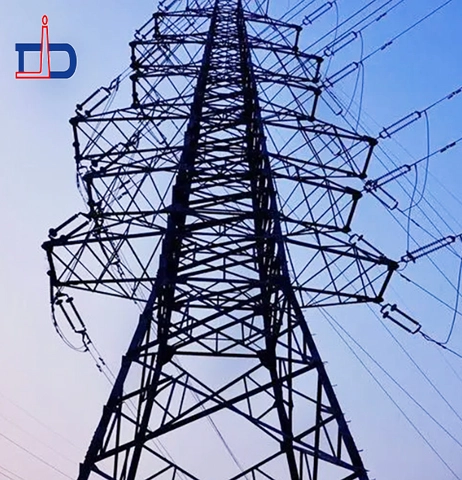
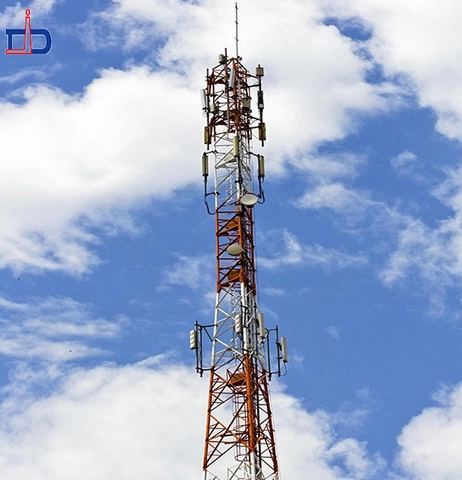
Typically a lattice-type steel structure constructed from angular or tubular members.
Multi-legged (usually 3 or 4), bolted together to form a trussed framework.
Designed to carry high-voltage power transmission conductors, often across long spans and in multi-circuit configurations.
Heights range from 15m to 100m+, depending on voltage level and terrain.
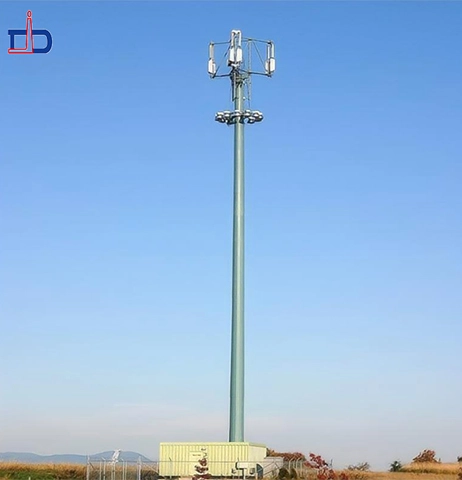
A single-shaft vertical structure, either circular or polygonal in cross-section.
Made of tapered tubular steel sections, joined via flanges or slip joints.
Widely used for telecommunication antennas (telecommunication monopole), distribution-level power lines, street lighting, and compact transmission lines.
Typical heights range from 10m to 45m, though custom designs may exceed that.
Key Takeaway:
Transmission towers are multi-member truss structures, while monopoles are single-column designs. This core distinction shapes their performance, cost, and deployment.
| Feature | Transmission Tower | Monopole |
Load Capacity | Very High – Supports multiple conductors and heavy wind/ice loads | Moderate – Suitable for lighter loading applications |
Typical Use | 110kV–500kV power lines, multi-circuit or long-span systems | 10kV–132kV lines, telecom antennas, urban infrastructure |
Flexibility | Highly customizable for extreme terrain or voltage specs | Limited modularity; used in compact or standard settings |
Resilience | Excellent in harsh weather and challenging topography | Adequate for mild to moderate environments |
Monopoles cannot match the load-carrying capacity or span reach of traditional lattice transmission towers, making them less suitable for long-distance EHV applications.
Built from angle or tubular steel, cut, punched, and galvanized.
Engineered for precise truss geometry, taking into account conductor tension, wind load, and seismic conditions.
Component-based design facilitates scalable customization.
Fabricated by rolling steel plates into tapered tubes, then welding.
Requires specialized equipment for forming, joining, and galvanizing long tubular sections.
Engineering is typically less modular but streamlined for repetitive, high-volume production.
Procurement Insight:
Transmission towers offer greater customization and flexibility; monopoles provide simplified design and manufacturing for projects with standard load requirements.
| Metric | Transmission Tower | Monopole |
Footprint | Large (requires wide foundation spread) | Compact (ideal for space-constrained areas) |
Installation Time | Longer (complex bolting and guying) | Faster (few sections, crane-lifted) |
Foundation Type | Multi-leg spread footings or pile groups | Single deep pile or pad footing |
Construction Labor | High – Skilled crews required | Lower – Simple assembly with crane |
Monopoles are particularly advantageous for urban projects where real estate is limited and fast deployment is essential. Transmission towers are better suited for rural, open, or mountainous sites.
Transmission Towers:
Shipped in bundled components, easy to fit in standard containers.
Ideal for remote or export projects with limited road access.
Site assembly required; parts may be carried by hand or small trucks.
Monopoles:
Shipped in large sections, often requiring flatbed trailers or special permits.
Not ideal for hard-to-access terrains due to bulk and weight.
Quicker to install once on-site, but less logistically flexible.
For international shipments or mountainous sites, transmission towers offer clear advantages in transport efficiency and flexibility.
Sleek, minimalistic design preferred for urban and aesthetic-sensitive zones.
Less visual clutter and easier to integrate with urban landscapes.
Reduced opportunities for bird nesting and lower surface area for debris.
Bulkier, industrial appearance.
Visual intrusion is more significant but often acceptable in rural or utility zones.
Open lattice design provides lower wind resistance and better stability.
Urban planners and city authorities often mandate monopoles for zoning approvals due to their low-profile, clean design.
| Cost Element | Transmission Tower | Monopole |
Material Cost | Lower per ton (angle steel efficient) | Higher due to tubular tower design |
Fabrication Cost | Lower; simpler cutting & punching | Higher; welding, forming required |
Installation Cost | Higher due to labor-intensive process | Lower due to faster erection |
Transportation Cost | Lower (flat-pack components) | Higher (bulk transport of long sections) |
Maintenance Cost | Moderate (bolt checks, corrosion) | Lower (fewer parts, easier access) |
Total cost varies by project type. Monopoles may have lower lifecycle costs for urban or telecom applications, while transmission towers remain more economical for long-distance and high-voltage lines.
Both types can be designed to meet:
IEC 60826, ASCE, or IEEE standards for structural integrity.
National grid or utility specifications.
Environmental compliance for corrosion, seismic, and wind loads.
Hot-dip galvanization standards such as ASTM A123 or ISO 1461.
However, transmission towers offer greater design flexibility to meet complex regional or utility-specific standards—particularly for long-span or mountainous projects.
| Scenario | Preferred Solution |
Rural 220kV transmission across rough terrain | Transmission Tower |
Urban 66kV power distribution in space-limited area | Monopole |
Remote substation interconnect in desert climate | Transmission Tower |
Telecom antenna support in residential zone | Monopole |
Dual-circuit 132kV line crossing a river valley | Transmission Tower |
Fast-deployment power lines for urban expansion | Monopole |
The transmission tower vs. monopole decision comes down to a strategic evaluation of load demand, site conditions, installation timeline, aesthetics, and cost structure.
Choose Transmission Towers when your project demands:
High-voltage, long-span, or multi-circuit configurations
Rugged terrain or remote installations
Modular design and transport efficiency
Choose Monopoles when your project benefits from:
Minimal footprint and urban compatibility
Quick installation and reduced labor costs
Cleaner appearance and lower maintenance
At Jintong, we manufacture and export both tower types, custom-engineered to meet your technical specs, budget, and regional standards. Whether you're designing a national grid extension or a dense city telecom network, we can provide the structural solution that aligns with your goals.
Yes. Steel monopoles can be engineered for high-voltage transmission applications when their structural capacity, conductor clearances, foundation, environmental loads, and applicable utility requirements are properly evaluated. Suitability should be determined by project-specific engineering rather than voltage alone.
A monopole uses one tubular steel shaft, while a lattice transmission tower distributes loads through a framework of interconnected steel members. Monopoles generally require a smaller ground footprint, whereas lattice towers provide greater structural configuration flexibility for demanding long-span and heavy-load applications.
The primary advantage is their compact footprint. A monopole can occupy less ground space and create a cleaner visual profile, making it useful in urban or suburban corridors where available right-of-way is limited.
Typical information includes voltage level, circuit configuration, conductor and OPGW specifications, tower height, span, line angle, wind and ice loads, project location, soil conditions, applicable standards, quantity, and delivery requirements. These details allow the manufacturer to evaluate the required structure and prepare a more accurate proposal.